Investigation of Zinc Migration from Rigid Needle Shield to Drug Formulation in Needle Tip of Pre-filled Syringe Using Synchrotron CT and Synchrotron X-ray Fluorescence Spectroscopy

Merck & Co., Inc. (known as MSD outside the United States and Canada) is a leading global pharmaceutical company focused on the development of innovative medicines and vaccines. The company has a strong track record in biologics and drug-device combination products, including advanced pre-filled syringe (PFS) systems designed for patient-centric drug delivery.
PFSs are increasingly used in such combination products to enable convenient and reliable drug administration outside clinical settings. This approach improves patient accessibility while reducing healthcare costs. However, the use of high-concentration protein formulations, particularly for subcutaneous delivery, has introduced new challenges, including needle clogging. While increased viscosity is a key contributing factor, recent studies suggest that chemical stability aspects may also play a role. In particular, zinc (Zn) migration from the rigid needle shield (RNS) has been hypothesized to contribute to viscosity changes, gelation, and ultimately clogging under certain conditions. However, direct experimental confirmation of metal ion migration into the drug product—especially for Zn—has remained limited until now.
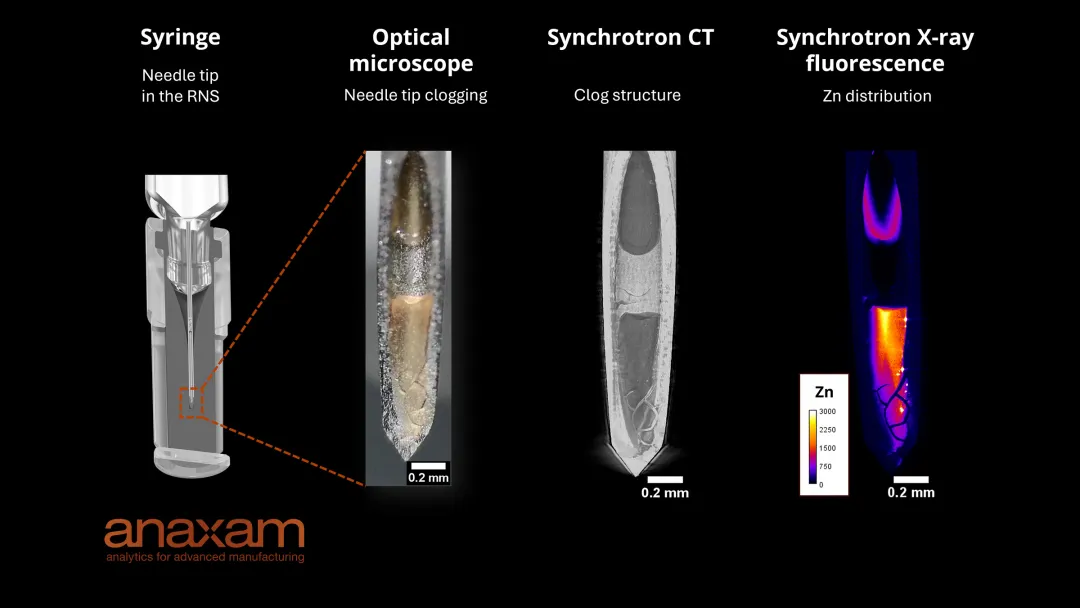
ANAXAM’s applied materials analytics using Synchrotron CT and Synchrotron X-ray Fluorescence Spectroscopy were used to investigate Zn migration from the RNS into the drug formulation during liquid-RNS contact. This work provides direct experimental evidence of Zn migration into the drug within a real pre-filled syringe system. Notably, Zn migration was negligible under storage at 5°C, while significant accumulation occurred under elevated temperature conditions, underlining the critical role of storage conditions in mitigating clogging risks. While Zn is not solely responsible for needle clogging, its presence in both the RNS and the drug formulation suggests a contributory role. These insights enable data-driven strategies to improve the design, storage, and reliability PFS systems.
For this customer project, ANAXAM used TOMCAT and MicroXAS beamlines at the Paul Scherrer Institute.
This study offers the first experimental evidence of Zn migration from the RNS into drug formulations within staked-in-needle PFSs. These insights will inform strategies for improving PFS performance and reliability for patients.”
Dr. Guangli Hu, Director, Device Development & Technology,
Merck & Co., Inc.